Caterpillars You Know Those Worm Looking Things
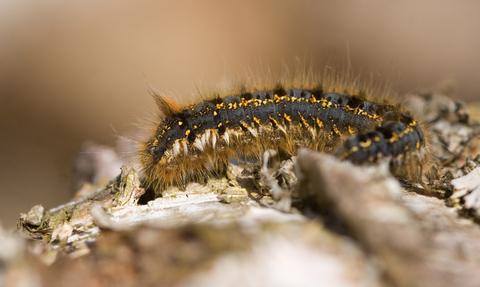
Drinker moth caterpillar ©Tom Marshall
How to identify caterpillars
What is a caterpillar?
A caterpillar is the larval phase of a moth or butterfly. It is the second office of their iv-stage life cycle (egg, larva, pupa, developed). Caterpillars have long, worm-like bodies with half dozen true legs. They tin also take a variable number of stumpy faux legs (called prolegs), which help them to move and cling to things.
Caterpillars can change dramatically from when they first hatch to when they're set to pupate. Some can increment their body mass ten,000-fold in but a few weeks - that's like a baby growing to the size of a sperm whale! Many look very different as they grow, so nosotros've described the larger stages of the caterpillar's growth, when they're oftentimes more obvious.
Which caterpillars am I likely to meet?
Many of these caterpillars are most obvious when they're fully grown and looking for a place to either pupate or settle down for the winter, though some are hands spotted on their favourite food plants. Here are some of the species we're most frequently asked to identify.
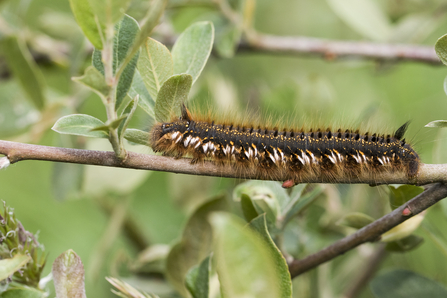
Drinker moth caterpillar ©Chris Lawrence
Drinker moth
When & where: August-June. A diverseness of habitats including gardens, only especially clammy grassland, marshes and boggy areas.
Clarification: Upwards to 7 cm long. Dark and covered with brownish hairs and aureate speckles. A row of white hairs runs down each side of the body.
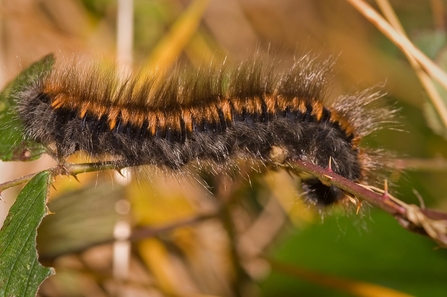
Fox moth caterpillar ©David Longshaw
Play a joke on moth
When & where:June-April, most obvious in leap. Mutual habitats include heathland and coastal grassland.
Description:Upwardly to 7 cm long. Hairy, with long dark hairs on the sides of the body and shorter orange hairs on acme. Immature caterpillars are dark with orangish bands.
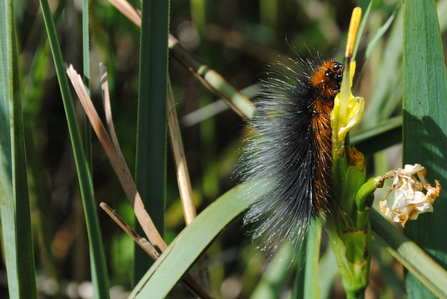
Garden tiger caterpillar ©Amy Lewis
Garden tiger
When & where:August-June. A wide range of habitats including gardens.
Clarification: Up to 6 cm long. An extremely hairy caterpillar, known as the "woolly bear". Mostly black and ginger, with longer white hairs.
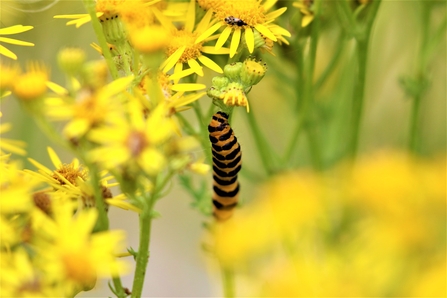
Cinnabar moth caterpillar ©Andrew Hankinson
Cinnabar
When & where:July-September. Found on ragwort in most grassy habitats.
Clarification:The caterpillars of this moth are distinctive, with blackness and yellowish stripes - warning predators that they taste terrible. They're easily spotted feeding on ragwort.
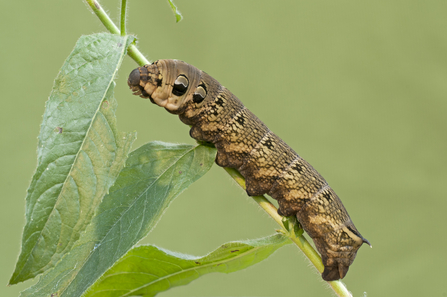
Elephant hawk-moth caterpillar ©Dawn Monrose
Elephant hawk-moth
When & where: June-September.A diverseness of habitats, including gardens. Often where rosebay willowherb is found.
Description: Upwards to 8.5 cm long. A chunky dark-green or brown caterpillar, with several eyespots at the front end and a spiky 'tail' at the rear.
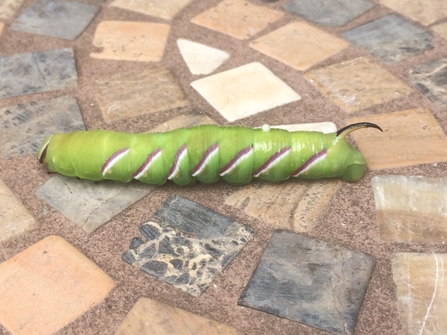
Privet hawk-moth caterpillar ©Roy Bedborough
Privet hawk-moth caterpillar
When & where: July to September. Widespread in southern England and Wales. Found in a variety of habitats, including gardens.
Description: Upwardly to 8.5cm long. Green and mesomorphic, with purple and white stripes on the body and a blackness and yellow horn on the rear.
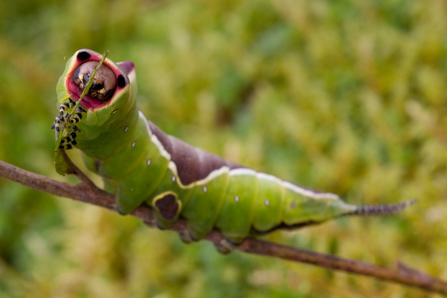
Puss moth caterpillar ©Vaughn Matthews
Puss moth caterpillar
When & where: June to September. Widespread in a variety of habitats, including parks, gardens and wetlands.
Description: A plump, green caterpillar with a dark, white-edged 'saddle'. The head is surrounded past a pink patch, with false optics making information technology wait like a giant face. There are two sparse tails.
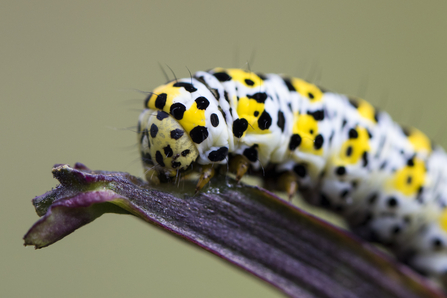
Mullein moth caterpillar ©Chris Lawrence
Mullein moth
When & where:Apr-July. A range of open up habitats, including gardens. Feeds on mulleins and buddleia.
Clarification:Distinctive whitish caterpillars, with horizontal yellow splodges across the trunk and big blackness spots.
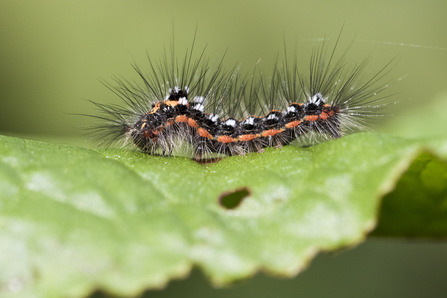
Yellowish-tail moth caterpillar ©Chris Lawrence
Yellow-tail
When & where:August-June. Scrubby habitats including hedgerows, woodland and gardens.
Description:Black with long, greyish-white hairs. On acme it has a pair of red lines, with a row of white blotches either side of them. A cherry line runs along each side. The hairs can be an irritant.
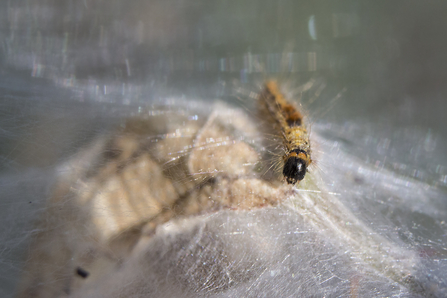
Brown-tail moth caterpillar ©Chris Lawrence
Brown-tail
When & where:August-May. Scrubby habitats, including coastal scrub.
Description:Black with long brown hairs, red spots on top and a line of white marks forth each side. Found in conspicuous communal webs on food plants. The hairs cause skin irritation. (Younger caterpillar pictured)
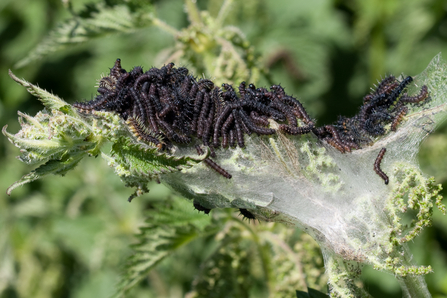
Peacock caterpillars ©Vaughn Matthews
Peacock
When & where:May-July. Mutual in a range of habitats where common nettle is present.
Clarification:Upwards to 4.v cm. Black with black spines and small white dots. Institute in communal webs on common nettles.
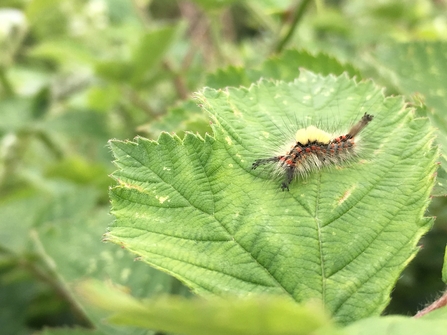
Vapourer moth caterpillar ©Tom Hibbert
Vapourer
When & where:May-September. Commonly institute in a variety of habitats including woodland, parks and gardens.
Description: A funky-looking grey and black caterpillar, with large tufts of pilus, including a mohawk of yellowish tufts on the dorsum. Large caterpillars can often exist spotted in late summer on a range of shrubs and copse.
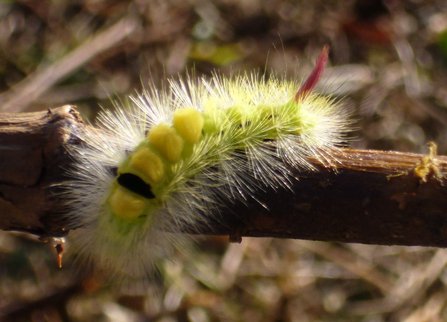
Pale tussock caterpillar ©Lizzie Wilberforce
Pale Tussock
When & where: June-Oct. Constitute on a wide variety of deciduous trees and other plants, including bramble.
Description: A hitting bright light-green caterpillar, with blackness bands betwixt its body segments, yellow/whitish hairs, a row of yellow tufts on top and a cerise tuft at the rear.
Not a caterpillar!
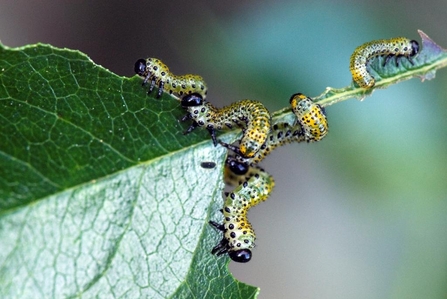
Rose sawfly larvae ©Les Binns
Sawfly larvae
Sawflies are a group of flies, whose larvae look very similar to caterpillars. The larvae are usually 1-4 cm long, but come in an impressive variety of colours. One mode to spot a sawfly larva is to count the legs - they also have half dozen true legs, but usually have 6 or more pairs of the stumpy 'prologs', whereas caterpillars have five or fewer.
How y'all tin can help
As a charity we rely on memberships. They help u.s. look after over 2,300 nature reserves and protect the animals that call them home.
Bring together for every bit niggling every bit £iii a month
Bertie Gregory/2020VISION
Become wild animals updates straight to your inbox
Go monthly newsletters packed with conservation news, exciting wild fauna updates and information on our latest campaigns!
Sign up
More about moths and collywobbles
Source: https://www.wildlifetrusts.org/wildlife/how-identify/identify-caterpillars
0 Response to "Caterpillars You Know Those Worm Looking Things"
Post a Comment